← Back to all work Case Study · Tbo.com

How User Research Can Drive Product Innovation.

Travel agents across the globe were using a platform that had never once asked them what they needed. Here's how I built a research practice from scratch to change that.

Duration Jan – Jun 2023
Role Design Consultant
Scope Global · 8 markets
Status 🔒 NDA · Selective details
0→1

Research practice built from scratch — the first study in the product's history.

8

Global markets surveyed across Asia Pacific, Europe, Latin America & North America.

25+

In-depth offline interviews conducted at travel agents' offices in Jakarta.

7

Outputs — personas, journey map, impact framework, usability report, recommendations, blueprint & shipped UI improvements.

A platform serving the world.
With no understanding of the people using it.

Tbo.com connects thousands of travel agents to suppliers worldwide. Its reach spans every continent — thousands of daily users searching, comparing, and booking. Business was growing and features kept shipping. But no one on the product team had ever observed a travel agent at work.

Decisions about what to build relied on assumptions, not evidence — a quiet risk for a platform operating at scale.

There is a gap between the organisation and its customers — the organisation is unaware of the real wants and needs of its travel agents.

Before running any research,
I had to map where the product was failing.

I began by mapping the system, not the screens — internal conversations, stakeholder interviews, tracing the customer journey by hand. A strategic gap surfaced: features were being designed around an inaccurate model of the user, and no one inside the company had named it yet.

The strategic brief I set for myself: "Build a programme rigorous enough that its findings couldn't be dismissed, and repeatable enough to become a new standard for how this team makes decisions."
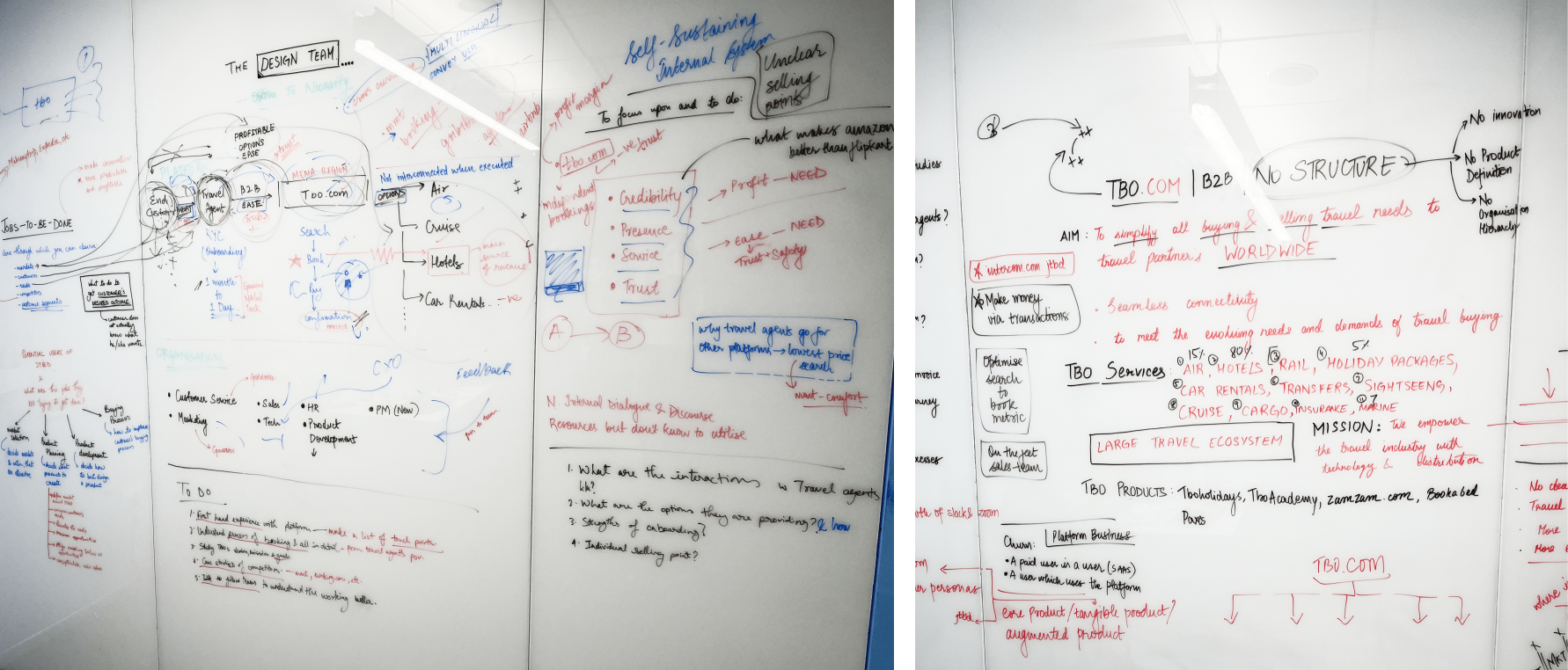
Whiteboard mapping the design today, platform breakdown and focus areas
"The Design Today" — mapping the platform, the organisation, and where to focus first.
Strategic frame

Three constraints shaped every decision: earn trust with a team unfamiliar with research, build evidence rigorous enough to survive senior scrutiny, and leave a system the team could keep using after the engagement ended. The four-stage methodology below is the answer to those three.

A four-stage methodology

I

Discover

  • Internal stakeholder sessions
  • Usability testing of the live platform
II

Listen

  • Global survey across 8 markets
  • Offline in-depth interviews in Jakarta
III

Synthesise

  • Cross-referencing quantitative & qualitative data
  • Impact metrics framework development
IV

Act

  • Personas, journey map, recommendations
  • Presentation to global leadership

First the platform.
Then the people.

Usability testing

I mapped every feature, tested it the way users actually used it, and documented every point of friction. A pattern surfaced quickly: users were uncertain about whether the information they were seeing could be trusted. Pricing changed. Fees appeared without context.

A global survey

Deployed across 8 markets, segmented by user cohort, translated into English, Spanish, Portuguese, Italian, Greek, and more — around 1,450 responses across cohorts. Three themes dominated the data:

Theme

Volatile Prices

Prices changing while users performed actions — eroding confidence at the exact moment a transaction needed to close.

Theme

Ease of Amendments

Difficulty making online changes post-booking, pushing critical workflows off-platform to WhatsApp and email.

Theme

Lack of Details

Missing hotel and room images, leaving agents unable to confidently sell what they were booking.

I flew to Jakarta
to sit inside the world our users actually work in.

Strategic choice · Why Indonesia?

Of the 8 surveyed markets, Indonesia ranked highest on user density and showed the steepest survey signals on the friction themes. Where the data was loudest, the qualitative answers were most likely to live. Field investment had to follow signal.

For five consecutive days I visited travel agencies across Jakarta, conducted interviews at agents' desks, and observed real-time platform usage while agents fielded calls from clients on the other line.

Shadowing them through daily workflows — client relationships, every feature touched, every workaround used — I documented what they found, what they used, and what they wished was different. Nothing assumed. Everything written down.

5 days in market
25+ agents shadowed
8 agencies visited
Aishani conducting an interview at a travel agent's desk in Jakarta Interview · Day 2
Walking through the tbo.com platform with a travel agent Platform walkthrough
Meeting with senior agency leadership in Jakarta Agency leadership session
Briefing session with the local team in Jakarta Briefing session · Jakarta
Aishani with the tbo.com Jakarta team after fieldwork
With the tbo.com Jakarta team — after a week of agency visits and shadowing.

Two walls of data.
One coherent picture.

Mind-mapped synthesis wall — qualitative insights from agent interviews
Wall 1 · Qualitative insights from 25+ interviews
Mind-mapped synthesis wall — quantitative survey patterns
Wall 2 · Quantitative themes across 8 markets
Finding 01

Trust Breakdown

Pricing inconsistencies and late-appearing fees were causing agents to lose confidence at the exact moment a transaction needed to close.
Strategic implication: Trust has to be designed for — not promised. Pricing transparency moves from a UX nicety to a revenue lever.
Finding 02

Platform Design Misalignment

The platform was built for one person. A booking involves five.

Bookings moved through clients, suppliers, managers, and finance, but the platform modelled none of this. Agents patched gaps using WhatsApp, email, and spreadsheets.

Strategic implication: The product's mental model is wrong. Reshape it around the booking workflow, not the booking user.

From insight to interface —
seven outputs that shifted the product.

Every insight had to be backed by both numbers and narrative — a deliberate rigour for a team unfamiliar with formal research. Six artefacts framed the thinking; the seventh shipped it.

01

User Personas

Two fully realised personas built from real interviews — not assumptions.

02

Journey Map

Five stages from Awareness to Continued Use, with the full emotional arc.

03

Impact Framework

Every finding connected to a business outcome — evidence over opinion.

04

Usability Report

Prioritised friction points with specific, actionable next steps.

05

Product Planning

Targeted directions for the product team's planning cycles.

06

Research Blueprint

A 10-stage repeatable process so research never starts from scratch again.

07

Shipped UX & UI Improvements

Translated insights into live product changes — refining the platform's interface and workflows to directly address the friction surfaced in research.

The findings didn't sit in a document.
They went into rooms.

Aishani presenting research findings to global leadership
Presenting findings to global leadership — Highlights from 6 months of research.

Global Alignment

Sales heads across every market aligned on a shared, evidence-based understanding of user needs — for the first time.

Team Training

The Indonesian sales team was trained directly from interview insights, embedding the user voice into market-closest teams.

Product Roadmap

The impact framework now connects every feature to user value, market reach, and expected outcome.

Repeatable Practice

A 10-stage research blueprint ensures the team never starts from scratch again — research is now part of how the product is built.

From gut feel to evidence.

What began as a single research project became a new standard for how decisions get made — and a product that demonstrably reflects it. Assumption gave way to conviction. Opinion gave way to outcome.